
How to Search Escambia County Traffic Court Records
Traffic records are searched through the Escambia Clerk's case portal and the Clerk's traffic-citation services. The citation number, printed on the ticket, maps right to the county-court traffic case, so it is the strongest search key. A name search works too, but it can return several people. Follow these steps:
- Open the Escambia Clerk traffic citation page or the public case portal.
- Search by citation number, or by case number if you have it.
- If you lack the number, search by last name and first name.
- Confirm whether the citation is a civil infraction or criminal traffic.
- Review the court date, the amount due, and the disposition.
Some Florida counties accept payment through a statewide county-services portal. The screenshot below shows MyFloridaCounty, used for traffic and records workflows where the local clerk supports it.

Confirm with the Escambia Clerk whether MyFloridaCounty, Clerk e-pay, or another method is active for an Escambia citation before you pay.
Which Courts Handle Traffic Cases in Escambia County
Most traffic matters are County Court cases, supported by the Clerk's traffic division. Criminal traffic, like DUI, can route through the criminal side. The table lists where traffic cases land.
| Court | Traffic Cases Handled | Address |
|---|---|---|
| Escambia County Court | Civil traffic infractions | 190 W Government Street, Pensacola |
| Escambia County Court (criminal) | Criminal traffic, including some misdemeanors | 190 W Government Street, Pensacola |
| Circuit Court | Felony traffic, such as serious DUI | 190 W Government Street, Pensacola |
The Clerk's traffic counter handles payments and court-appearance options across these divisions. For the lower court itself, see the Escambia County Court page.
Types of Traffic Cases on Record
Traffic cases split into two broad groups, and the group decides your options. Civil infractions are noncriminal violations like speeding. Criminal traffic charges are crimes that can carry jail. Mixing them up leads to missed steps.
- Civil infractions, such as speeding and other moving violations.
- Nonmoving violations, like equipment or registration issues.
- Criminal traffic, including DUI, reckless driving, and driving while license suspended.
- Leaving the scene and other serious traffic crimes.
A civil infraction can usually be paid, contested, or resolved with a driver-improvement course if eligible. A criminal traffic charge can require a court appearance and create a criminal record.
What Escambia County Traffic Court Records Show
A traffic record holds the citation details, the court process, and the outcome. The table lists the fields you can expect on a typical case.
| Field | What It Shows |
|---|---|
| Citation / Case Number | The ticket number and the court case identifier. |
| Driver Name | The cited driver; the license number is often restricted. |
| Violation Details | Date, time, location, statute, and charge description. |
| Classification | Civil infraction or criminal traffic. |
| Court Date | Hearing or due date, and any mandatory appearance flag. |
| Plea / Election | Payment, school election, or hearing request. |
| Financials | Fine, court costs, late fees, and balance. |
| Disposition | Paid, dismissed, adjudicated, withheld, or failure to appear. |
A crash report is a separate record. The screenshot below shows Florida traffic crash report access.

A single crash can create a citation, a court case, a crash report, an insurance claim, and a civil lawsuit, and the court traffic record will not hold the full crash narrative.
Searching by Citation Number vs by Name
The citation number is the strongest key because it ties to one ticket. A name search is a fallback that can return several people, so confirm the match. The table lists the search fields.
| Search Field | Type | Required | Notes / Format |
|---|---|---|---|
| Citation Number | Text | No | Best search key; printed on the ticket. |
| Case Number | Text | No | Court case identifier. |
| Last Name | Text | No | Name search. |
| First Name | Text | No | Narrows the search. |
| Date Range | Date | No | Filing or citation date. |
Paying or Contesting an Escambia County Traffic Ticket
The citation prints a deadline. Acting before it matters, since a missed deadline can add fees, a license hold, or collections. You have a few options, depending on the ticket. Follow these steps:
- Read the citation deadline first.
- Search by citation number on the Clerk traffic page.
- Confirm whether the citation is a civil infraction or criminal traffic.
- Choose payment, a driver-improvement school election, or a hearing.
- Pay by an accepted method before the deadline if you are not contesting.
- If contesting, request a hearing and appear as noticed.
Paying a civil infraction can be treated as an admission and may add points, depending on the offense. A hearing request keeps the right to contest, but you must appear and bring evidence.
Public Access Laws for Traffic Court Records
Traffic court records are public under Florida law, like other court files, unless an exemption applies. The court traffic file follows the same judicial-records framework as other cases. Identity data such as a driver license number is often restricted from public display.
The framework rests on the Public Records Act in Florida Statutes Chapter 119 and the court-access rule. For a certified disposition, request it from the Clerk rather than relying on a portal printout, since employers and insurers may need the certified record.
Court Traffic Records vs State Driver Records
This is the distinction that trips people up. The court traffic record is the case file. The driver record is the license history. They live in different systems and answer different questions. The table compares them.
| Record Type | Source | What It Shows | How to Access |
|---|---|---|---|
| Court traffic record | Escambia Clerk | Citation, court date, plea, fine, disposition | Clerk case portal |
| State driver record | FLHSMV | License status, convictions, suspensions, points | FLHSMV driver record |
The screenshot below shows the Florida driver license check, a quick license-status tool.
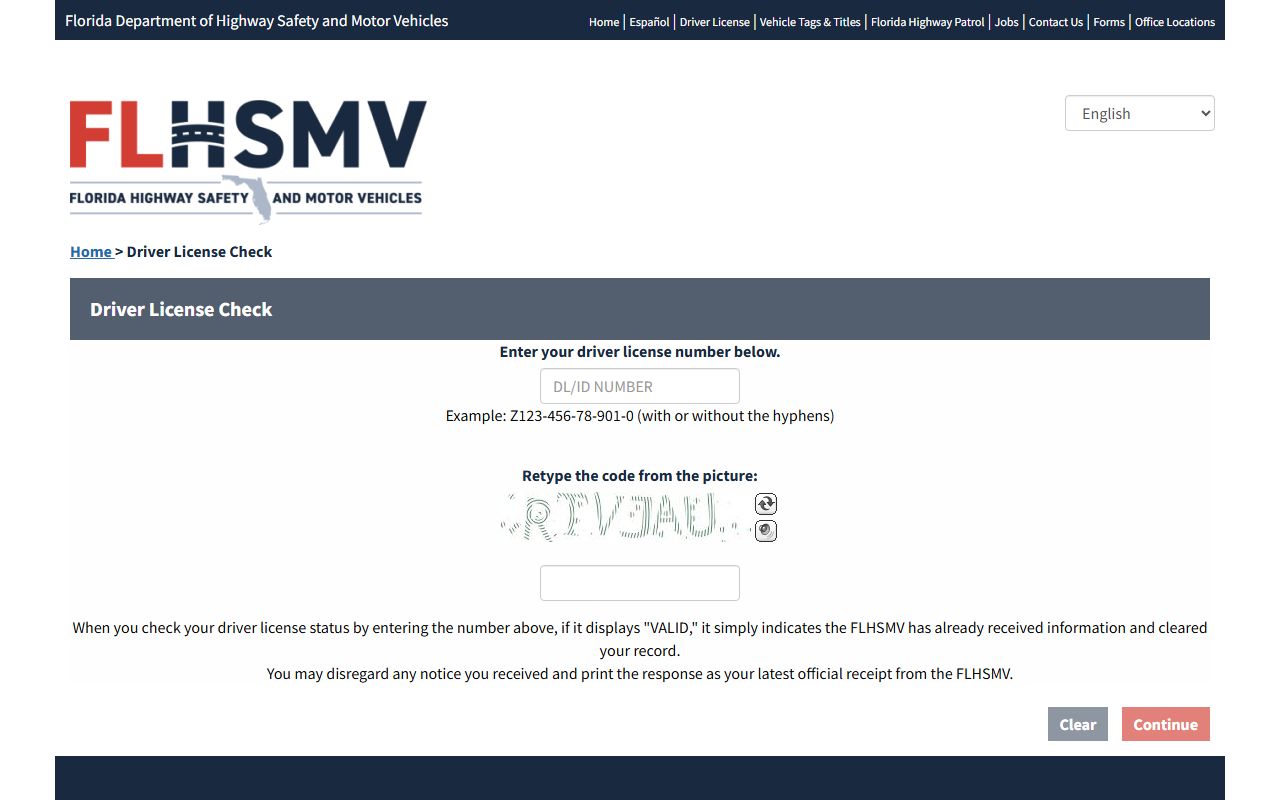
A license check is not a full driver history, and the court record is not the driver record, so a person may need both for an employer or an insurer.
CDL and Commercial Driver Records
Commercial driver license holders face stricter rules. Federal and state CDL rules restrict masking convictions and require reporting of many violations. A CDL holder should not assume a driver-improvement course or a withhold of adjudication prevents employer, state, or federal reporting.
A Florida citation can also affect an out-of-state license through interstate reporting. Because Escambia County borders Alabama, out-of-state drivers and license consequences come up often. A driver who holds a license in another state should expect the citation to reach the home-state record.
DUI and DWI Cases
DUI is not a simple traffic ticket. It is a criminal charge that can carry jail, a license suspension, and a criminal record. A DUI case can require a court appearance and may support Public Defender appointment if the person qualifies. Failure to appear in a criminal traffic case can lead to a capias or warrant, not just a late fee.
Because DUI sits on the criminal track, follow it through the criminal docket, not just the traffic portal. See arrest records for booking and charge detail, and warrant records if a failure to appear created a capias.
Driver-Improvement Course and Withheld Adjudication
Florida offers ways to limit the impact of a civil infraction. An eligible driver may elect a driver-improvement course, which can avoid points on the license for certain violations. The court may also withhold adjudication in some cases, which is different from a dismissal.
These options have limits. A withhold is not the same as the charge disappearing, and a CDL holder may not get the same protection. Confirm eligibility with the Clerk or the court before you elect a course, since the wrong choice can cost the option to contest.
Sealing or Expunging Traffic Records
Civil traffic infractions are generally not eligible for sealing or expunction the way some criminal records are. Criminal traffic charges, like a DUI, follow the criminal sealing and expunction rules, which require an FDLE eligibility review and a court petition.
A granted order limits official public access, but it does not erase private website copies. For the seal-and-expunge process tied to criminal traffic, see arrest records, and for the legal framework, see public records.
Fees for Traffic Record Copies
Copies and certifications carry fees set by the Clerk. The fine and court costs on a ticket are separate from copy fees. Confirm current amounts with the Clerk. The table lists the common copy items.
| Item | Amount |
|---|---|
| Plain copy per page | Statutory rate; verify with the Clerk |
| Certified copy | Per-page fee plus certification |
| Driver record copy | Obtained from FLHSMV, not the Clerk |
Note: The fine and costs on a citation are set by the case, while copy fees are set by the Clerk fee schedule.