
Escambia County Jail Roster Overview
Escambia County Corrections runs the county jail and posts the public Jail View inmate lookup. The Escambia County Sheriff's Office, led by Sheriff Chip Simmons, is the main law-enforcement agency, but Corrections handles detention and the roster. The public uses Jail View to search current inmates and, where shown, recent bookings and releases.
The roster answers a narrow question: who is in custody, on what booking, and with what bond. It does not show how a case resolves. The court docket is the better source for filed charges, hearings, pleas, and sentences. Pair the two. Jail View tells you about custody, and court records tell you about the case.
The Corrections landing page links to the roster, visitation, mail, and commissary tools.
This view of the Escambia County Corrections page shows the entry point for inmate services.
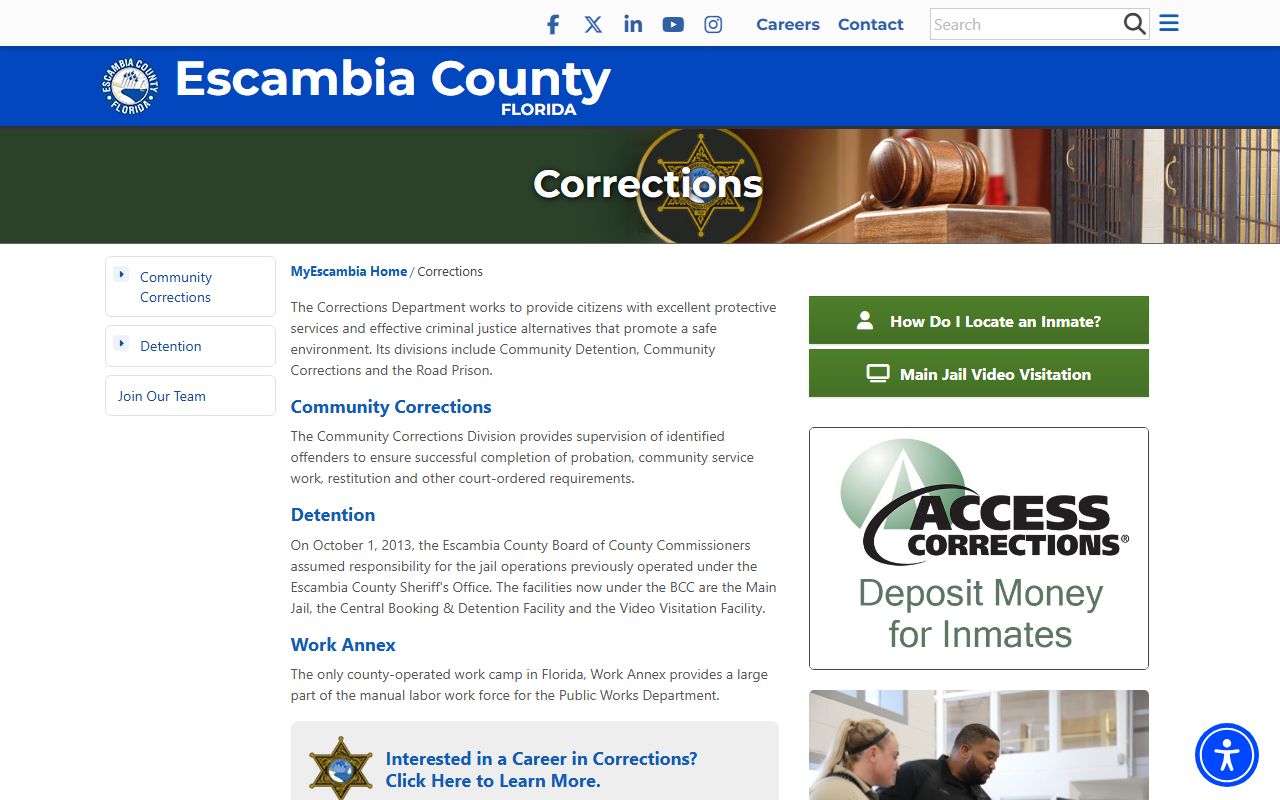
From there, the inmate lookup link opens the Jail View tool used for an Escambia County inmate search.
How to Use the Escambia County Inmate Roster
Jail View is built for name searches. Start with the last name, then add the first name to narrow the list. Confirm the match before you act on it.
The Jail View inmate lookup page is the direct tool for finding a person in custody.
The screenshot below shows the Jail View inmate lookup page.
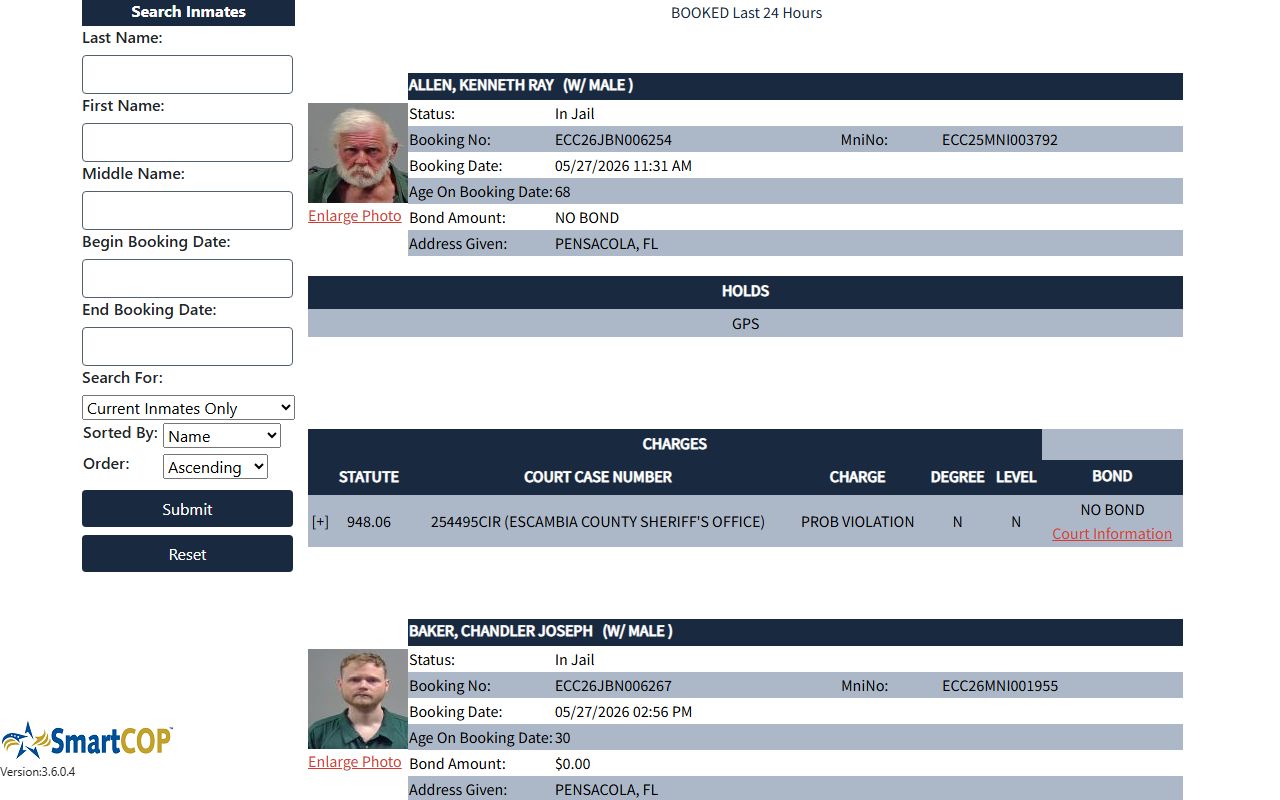
Use these steps to run a roster search:
- Open the Escambia County Jail View inmate lookup.
- Enter the last name, then the first name.
- Compare booking date, age, and charges to confirm the right person.
- Open the profile to read the booking number, bond, and housing.
- Call Corrections to confirm before posting bond or planning a pickup.
If a search returns nothing, the person may have been released, transferred, or never booked here. Jail data changes fast after court orders, so confirm by phone for any high-stakes decision.
Roster Search Fields
The Jail View tool keeps its fields simple. A name is the main key, with optional date filters and tabs for current or released status. The table lists the common fields.
| Field Label | Type | Required | Notes |
|---|---|---|---|
| Last Name | Text | No | Search by inmate surname. |
| First Name | Text | No | Narrows the name search. |
| Middle Name | Text | No | Narrows further if shown. |
| Booking Date | Date / Range | No | Used for booking or release lists where available. |
| In Custody / Released | Filter / Tab | No | Switches between current inmates and recent releases. |
| Search | Button | n/a | Runs the lookup. |
What an Inmate Profile Shows
A Jail View profile carries public booking fields. They describe the person and the custody status, but they leave out medical and security detail. The table lists the fields you can expect.
| Field | What It Shows |
|---|---|
| Name | The full booking name. |
| Booking Number | A unique jail booking identifier. |
| Booking Date / Time | The intake timestamp. |
| Age / Sex / Race | Demographic fields where shown. |
| Arresting Agency | The agency responsible for the arrest. |
| Charges | Charge text with a statute or case reference where shown. |
| Bond | Amount and type per charge where set. |
| Housing / Holds | Facility or pod where public, plus any holds. |
| Release Date | Shown after release where Jail View keeps the record. |
Note: Medical, mental-health, protective-custody, and victim details are not public roster fields, and a bond of zero can mean no bond has been set yet.
Escambia County Jail Facilities
Escambia County Corrections runs the main jail and related community-custody programs. The main facility holds most pretrial and sentenced inmates. A community detention program handles work release and supervised custody where active.
Escambia County Jail
2935 N L Street
Pensacola, FL 32501
Primary county detention facility
Community Detention
Escambia County
Pensacola, FL
Work release and supervised custody
The Community Detention page explains supervised custody and work programs in Escambia County.
This screenshot shows the Escambia County Community Detention page.
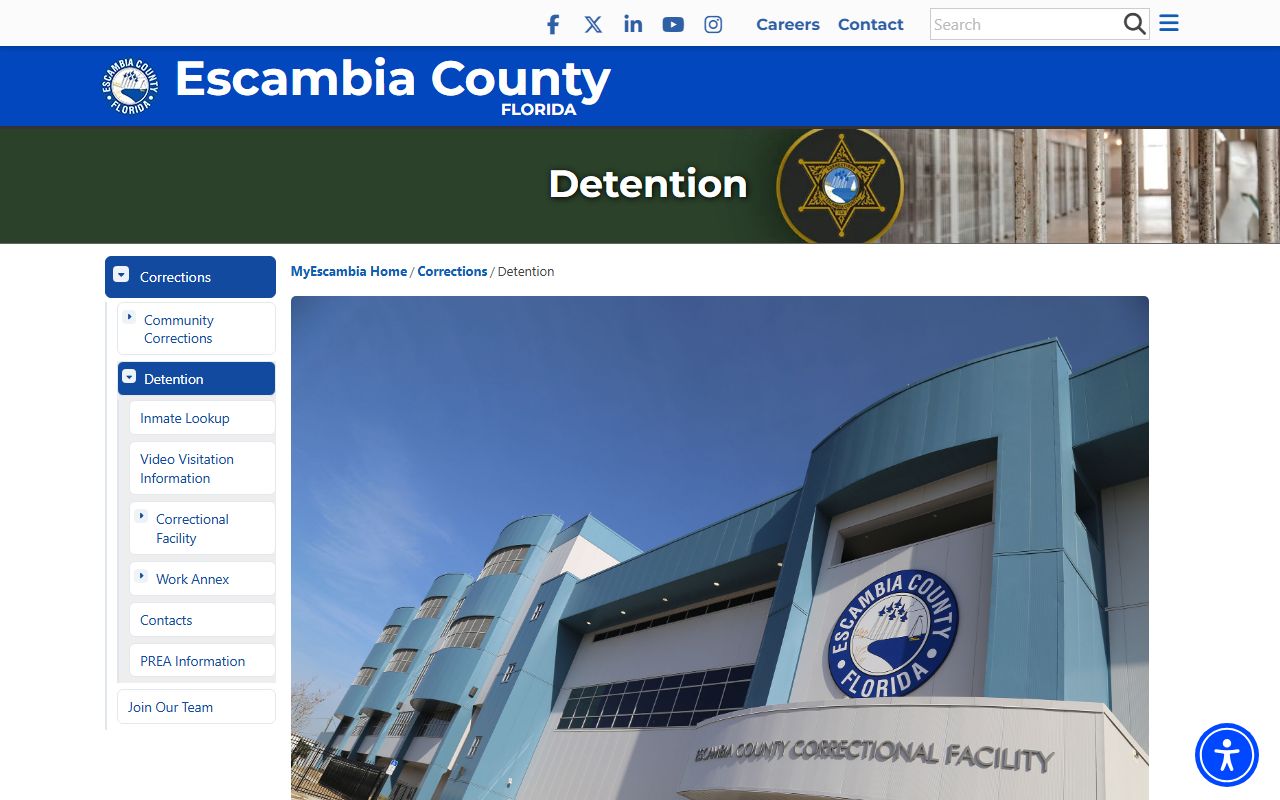
Current capacity and average population are not posted on a stable public page, so confirm any exact figure with Corrections or the county budget.
Booking Process in Escambia County
A person arrested in Escambia County is taken to the jail, identified, searched, medically screened, photographed, fingerprinted, and assigned a booking number. Charges, the arresting agency, bond status, and court information go into the jail system. First appearance generally happens soon after arrest, often within 24 hours for in-custody defendants under Florida procedure.
Booking is not prosecution. The jail records the law-enforcement reason for custody. The State Attorney decides what charges to file, reduce, or decline. So a Jail View charge line can differ from the later court charge. A person can have several bonds, one per charge, and a hold can block release even if a bond is paid. For the charge and case detail, search arrest records and the court records docket.
After booking, Corrections classifies each inmate. Staff weigh the charges, history, behavior, medical and mental-health needs, keep-separate orders, sex, age, and security risk. That classification sets housing, but detailed risk data is security-sensitive and not a public roster field. Personal property is inventoried at intake and stored under jail policy. Most street property cannot stay in housing. Released people get property back through the release process unless it is evidence, contraband, or held for another agency.
Visitation Hours and Rules
Visitation is a privilege set by jail policy and security needs. Rules can change after lockdowns, vendor changes, or construction, so confirm the current schedule on the official visitation page before you travel. The table lists the visitation rules to plan around rather than fixed daily hours, since exact times and the video vendor must be checked on the county page.
| Topic | Rule |
|---|---|
| Scheduling | Follow Corrections visitation steps; video visits may need a vendor account. |
| Identification | Adults need a government-issued photo ID. |
| Minors | Usually must be with a parent or legal guardian. |
| Dress code | No revealing, gang-related, or security-risk clothing. |
| Denial reasons | Warrants, no ID, intoxication, no-contact order, or prior suspension. |
| Attorney visits | Follow separate professional-visit rules and ID checks. |
The visitation page explains the current scheduling steps and ID rules.
This screenshot shows the Escambia County inmate visitation page.
Confirm the inmate is still housed at the Escambia County Jail before you plan a visit.
How to Contact an Inmate
Mail and phone are the usual ways to reach an inmate. Use the inmate's full name and booking number on mail if the jail requires it, and include a sender name and return address. Do not send contraband, cash, explicit material, or altered paper. Legal mail is handled separately to protect confidentiality, but it is still inspected for contraband.
The inmate mail page lists the address format and what cannot be sent.
This screenshot shows the Escambia County inmate mail page.
Phone and video services are vendor-operated, and most calls are recorded except protected attorney calls.
Commissary and Inmate Funds
Inmates can buy food, hygiene items, and stationery through the jail commissary. Family and friends can deposit money through the methods the county posts, which may include a kiosk, an online vendor, a phone vendor, or a money order. Deposits can carry vendor fees, and jail policy may deduct fees, restitution, or debt from an account.
The commissary page lists the current deposit methods and any vendor fees.
This screenshot shows the Escambia County inmate commissary page.
Send money only to the correct inmate, since funds sent to the wrong person can be hard to recover.
Bonds, Holds, and Release Timing
Bond and holds control whether and when a person leaves the jail. A cash bond is money posted directly. A surety bond is posted by a bondsman under a contract. Release on recognizance is a promise to appear with conditions. A no-bond hold keeps a person in custody until a judge changes the status.
Holds matter as much as bond. A person with several charges may need every bond and hold cleared before release. A probation violation, an out-of-county warrant, or a federal or immigration detainer can block release even if the local bond is paid. Release also takes processing time. The jail must receive the bond paperwork, verify holds, return property, and clear internal records. Do not assume release is instant after a bond is paid. If the timing is urgent for a pickup, medication, or shelter, call Corrections before you travel.
What Jail View Does Not Show
The roster is a custody tool with limits. It does not show medical or mental-health status, classification risk, protective-custody placement, or victim data. A release date does not always mean charges were dropped. It can mean a bond was posted, a sentence was served, a transfer happened, or a court ordered release. A booking entry never proves guilt.
Because the roster answers only part of the picture, use a verification ladder when the stakes are high:
- Jail View for present custody and booking details.
- The Clerk docket for filed charges, hearings, and disposition.
- The Sheriff's Office for warrant status.
- The Florida Department of Corrections for state-prison transfer or supervision.
- The Bureau of Prisons for federal custody.
County Jail vs State Prison vs Federal Custody
People sometimes vanish from the county roster but remain in custody elsewhere. Knowing which system holds a person tells you which search to run. The table compares the three.
| County Jail | State Prison | Federal Custody | |
|---|---|---|---|
| Who Runs It | Escambia County Corrections | Florida Department of Corrections | U.S. Bureau of Prisons |
| Typical Cases | Pretrial and short sentences | Felony sentences over one year | Federal convictions |
| Where to Search | Jail View | FDC offender search | BOP inmate locator |
A transfer to state prison or federal custody can look like a release from the county jail, but the person is still held. The released inmates page covers those state and federal searches in detail.