
How to Search Escambia County Court Records
Court records here are searched through the Escambia Clerk's public case portal. The portal indexes both Circuit Court and County Court cases. The basic flow is simple. Pick the record type, choose a search method, enter the strongest identifier you have, then review the results. For most people, case number is the best key. It points to one file. If you do not have it, search by last name and first name, then narrow by date or division.
Before you start, find any paper tied to the case. A summons, ticket, notice, or arrest form often prints a case or citation number. Have the full legal name ready, not a nickname. For a traffic case, the citation number is the strongest key. For probate, search the decedent's name rather than a family member's name.
These steps walk through a basic search:
- Open the Escambia Clerk Court page and choose the public court records portal.
- Pick a search type. Use case-number search when the number is on a notice or ticket.
- For a name search, enter the last name, then the first name.
- Add a date range or division filter when you know roughly when the case was filed.
- Run the search and open the case summary to read the docket.
- For legal use, request a certified copy from the Clerk.
If you get too many results, add a first name, middle initial, or date range. If a name returns nothing, try an alternate spelling, a maiden name, or a business name. A criminal case may not show right after an arrest because the State Attorney filing can lag the booking.
Escambia County Court Records Search Fields
The portal exposes a set of fields. You do not need to fill every box. One strong field often works better than several weak ones. The table lists the common fields and how each is used.
| Field Label | Type | Required | Notes / Format |
|---|---|---|---|
| Case Number | Text | No | Best identifier. Florida numbers include year, court type, sequence, and division. |
| Citation Number | Text | No | Used for traffic citations. |
| Last Name | Text | No | Party-name search. |
| First Name | Text | No | Narrows the party-name search. |
| Business Name | Text | No | For corporate or agency parties. |
| Date From / Date To | Date | No | Limits results by filing or event date. |
| Court Type / Division | Dropdown | No | Circuit Civil, County Civil, Criminal, Traffic, Family, Probate. |
Types of Escambia County Court Records
Court records here span many case types. Circuit Court handles the serious and complex matters. County Court handles smaller, high-volume cases. Public access is broad, but confidential details inside a filing are redacted. Juvenile records sit under tight restrictions and may not appear at all.
Florida sets the court structure that decides which court holds which record. The screenshot below shows the Florida Courts structure overview.
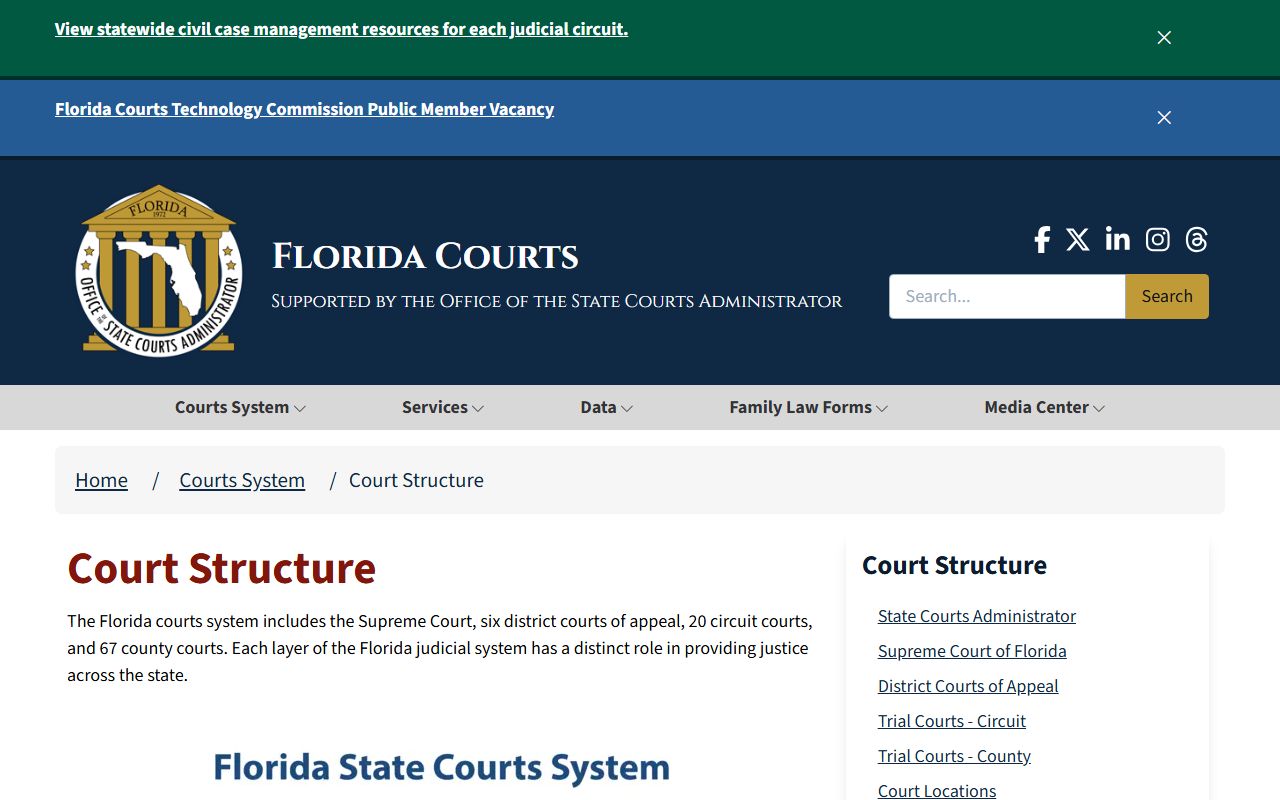
That hierarchy is why a felony file looks different from a small-claims file in Escambia County court records.
- Criminal records, including felony cases in Circuit Court and misdemeanors in County Court.
- Civil records, such as contract disputes, foreclosure, evictions, and small claims.
- Family records, including dissolution, paternity, custody, and support.
- Probate records for estates, wills, and guardianships.
- Traffic records, including citations, court dates, and dispositions.
What Escambia County Court Records Show
A case record is read in layers. The result list flags whether the case is likely yours. The case summary gives the filing date, court, status, and parties. The docket lists every event in order. Document images, when public, hold the pleadings and orders. A docket line that says "Order Entered" is not the order. The full document or a certified copy is what shows the ruling.
The table lists the fields you can expect on a typical Escambia Clerk case record.
| Field | What It Shows |
|---|---|
| Case Number | Florida case identifier, generally with filing year and division code. |
| Filing Date | The date the case was filed. |
| Court / Division | Circuit or County Court, plus civil, criminal, traffic, family, or probate. |
| Judge | The assigned judge or division, where shown. |
| Parties | Plaintiff, defendant, petitioner, respondent, or personal representative. |
| Status | Open, disposed, closed, reopened, or restricted. |
| Docket Entries | Filings, motions, orders, hearings, and disposition events. |
| Financial | Fines, fees, costs, payments, and balances where public. |
Note: Social Security numbers, bank data, minor identifiers, and protected addresses should be redacted or held back from public view.
Searching by Court Division
Each division indexes cases a little differently, so the search approach shifts with the record type. Circuit civil holds foreclosure, contract disputes, and other larger civil matters. Search by plaintiff, defendant, or case number. County civil holds small claims, evictions, and lower-dollar disputes, where eviction cases can move fast and show a summons, judgment, and writ of possession. Criminal felony cases are in Circuit Court, while misdemeanors are in County Court.
Family cases include dissolution, paternity, support, and injunctions. The docket may be public, yet child data, financial affidavits, and protected addresses can be held back. Probate searches work best by the decedent's name, not a family member's name. Civil traffic infractions are searched best by citation number. Older records or microfilm-era files may need Clerk staff help, so do not assume every old docket book is online.
Reading an Escambia County Court Docket
Court records use terms that carry exact meaning. A short list helps you read a docket without guessing. These terms show up across criminal, civil, family, and probate cases.
- Plaintiff
- The person or entity bringing a civil claim.
- Defendant
- The person or entity sued or charged.
- Motion
- A written request asking the judge for an order.
- Disposition
- The result of a case or a charge.
- Capias
- A Florida arrest writ, often issued after a failure to appear.
- Adjudication withheld
- A Florida disposition where the court does not formally adjudicate guilt.
When you need a copy that holds up in court, ask the Clerk for a certified copy. Provide the exact case number, party names, the document title, and the approximate filing date. Pay the copy, certification, and delivery fees. For out-of-state use, ask whether the copy must be exemplified or authenticated, which adds a further layer of certification.
Public Access Framework for Escambia County Court Records
Florida starts from open access. The state constitution and the Public Records Act make most government records open unless the Legislature writes an exemption. Court case files are judicial records under a separate court rule. So the Clerk's administrative records follow the records act, while court files follow the judicial rule. The result is broad access with different rules for the confidential parts.
You do not have to explain why you want a record. A request can be oral, written, or by email. Copy fees are set by law. A large request can carry an extensive-use charge for heavy staff or computer time. The core statutes are Florida Statutes Chapter 119 and court access Rule 2.420.
Note: A portal printout is not a certified record, so request a certified copy from the Clerk when a record is needed for court, licensing, or immigration.
Records That Are Sealed or Confidential in Escambia County
Some files are not open. Juvenile delinquency and dependency records are restricted. Adoption records are sealed. Mental-health and Baker Act files are protected. Grand jury work is secret. Some victim and domestic violence details are shielded, and identity data like Social Security and bank numbers are redacted.
To view a sealed record, a person usually needs a legal basis, party status, or a court order. Sealing and expunction differ. Sealing limits public access but lets some agencies still view a file. Expunction removes an eligible criminal record from ordinary public view more fully, with limited access kept for set purposes. Most expunction cases start with an eligibility review through FDLE, then a petition in the court that handled the case. The rules sit in Florida Statutes Chapter 943.
In-Person Court Record Requests
Some records are easier to get at the counter, such as older files, microfilm-era cases, or documents that need certification. Bring the case number, party names, and a photo ID. The contact card lists the main court address. Confirm current hours before you go.
Escambia Clerk of the Circuit Court
190 W Government Street
Pensacola, FL 32502
Court records counter
Confirm public counter hours before visiting