
About the Escambia County Clerk's Office
The full title of the office is the Escambia County Clerk of the Circuit Court and Comptroller, currently led by Pam Childers and branded as the Escambia Clerk. Florida clerks are constitutional officers under Article V and Chapter 28, Florida Statutes. The office is unified, which means one clerk supports both the Circuit Court and the County Court. The contact card lists the main office.
The dual role is worth knowing. As a court officer, the Clerk keeps case files, dockets, and official records. As county comptroller, the same office handles county finances, audits, and payments. For a records user, the court side is what matters most, but the comptroller role is why the Clerk can also speak to county financial records. The office cannot give legal advice, choose a form, predict an outcome, or tell a party what to argue.
Escambia Clerk of the Circuit Court and Comptroller
190 W Government Street
Pensacola, FL 32502
Court records, recording, marriage, traffic
The Clerk's official records page handles recorded instruments like deeds and liens.
This screenshot shows the Escambia Clerk official records page.
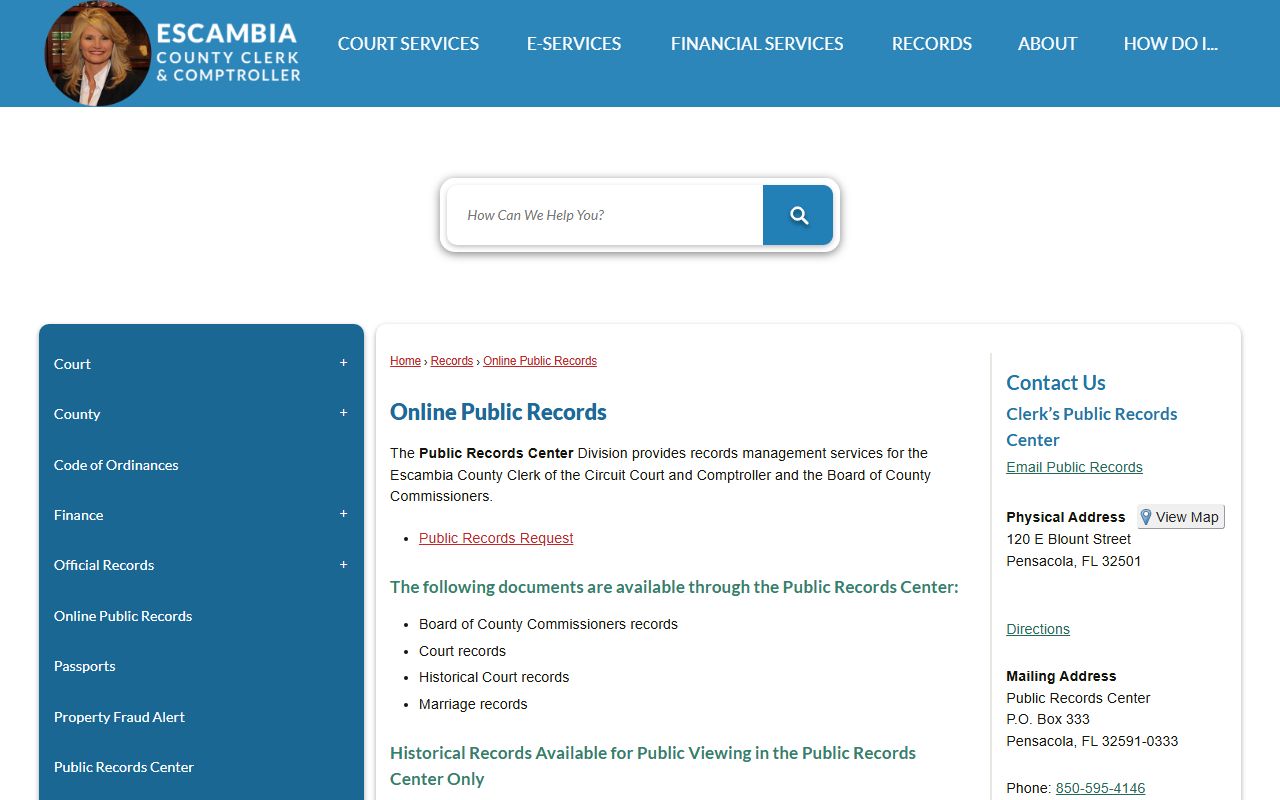
Recorded documents are separate from court case files, and each has its own search tool on the Clerk site.
What the Clerk Does in Escambia County
The Escambia County Clerk handles a wide set of court and county duties. For a records user, the most relevant ones are accepting filings, maintaining dockets, collecting court costs and fines, issuing certified copies, recording official documents, issuing marriage licenses, processing traffic payments, supporting probate records, and answering public-records requests. The Clerk also serves as county comptroller for government finances.
- Court records for Circuit and County Court divisions.
- Official records, including deeds, mortgages, liens, and satisfactions.
- Marriage licenses and recorded marriage records.
- Traffic citation payments and court-appearance options.
- Certified, plain, and exemplified copies on request.
Across the court divisions, the Clerk supports circuit civil cases like foreclosure and larger disputes, county civil cases like small claims and evictions, felony and misdemeanor criminal records, family and probate filings, and civil traffic. The office records the docket, collects fines and costs, and keeps the financial side of each case. That financial role is why a closed case can still show a balance due for fines, fees, or restitution.
Traffic is one of the busiest counters. The screenshot below shows the Escambia Clerk traffic citation page.
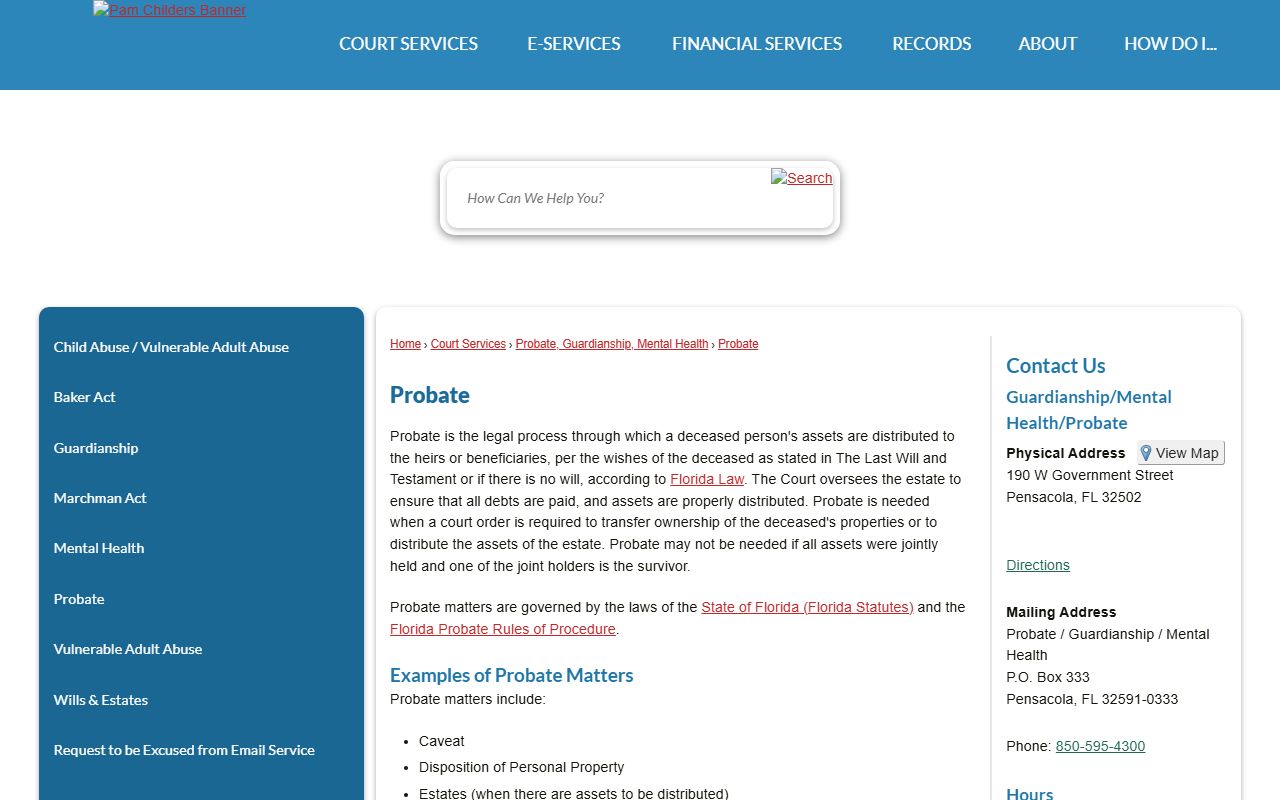
That page handles payment and court-appearance choices, while the court portal holds the traffic case docket.
How to Request a Certified Copy
A certified copy is the version courts and agencies accept. Request it from the Escambia Clerk rather than relying on a portal printout. Follow these steps:
- Identify the exact case number and the document title.
- Check whether the document image is public on the portal.
- Contact the Clerk with the case number, party names, and document name.
- Choose a plain copy, a certified copy, or an exemplified copy for out-of-state use.
- Pay the copy, certification, and delivery fees.
A certified copy carries the Clerk's certification. An exemplified or authenticated copy adds a further layer for another court or agency that needs stronger proof.
Records Request Form Fields
Whether you request a copy in person, by mail, or by email, the same details help the Clerk find the record. The table lists the fields a complete request includes.
| Field | Required | Notes |
|---|---|---|
| Case number | No | Speeds the search when known. |
| Party names | Yes | Used to locate the file. |
| Document title | Yes | The specific filing or order you want. |
| Filing date | No | Narrows older records. |
| Copy type | Yes | Plain, certified, or exemplified. |
| Delivery method | Yes | Pickup, mail, or electronic. |
Escambia County Clerk Fees
Florida sets many clerk fees by statute. The screenshot below shows Florida Statutes Chapter 28, which defines clerk duties and service charges.
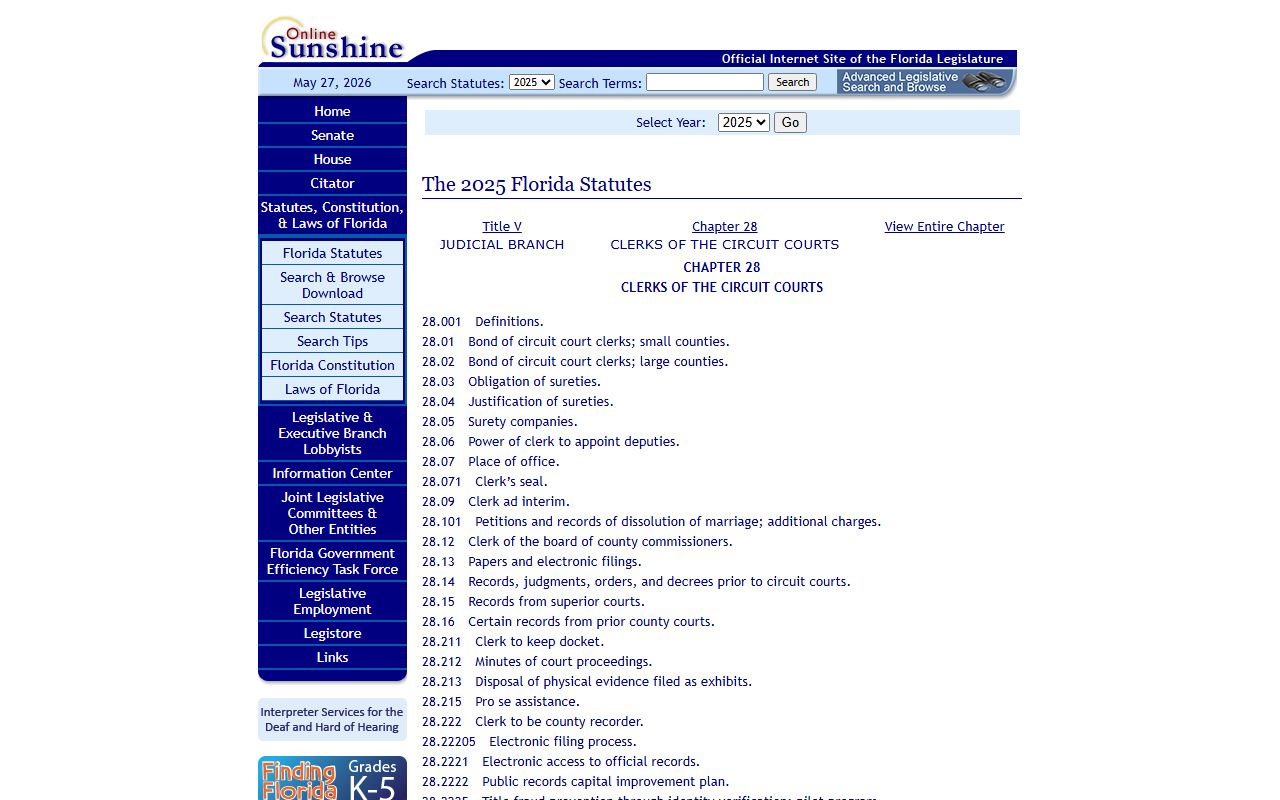
The statute sets many copy and certification charges, while the Clerk posts current amounts on the fee page. Confirm the figure before you pay. The table lists the common items.
| Item | Amount |
|---|---|
| Plain copy per page | Statutory rate; verify with the Clerk |
| Certified copy | Per-page fee plus certification |
| Recording per page | Statutory recording charge |
| Exemplified copy | Higher charge for added certification |
Note: A large or complex request can carry an extensive-use charge when it requires substantial staff or computer time.
Common Clerk Forms
Many filings start with a standard form. The Clerk can hand out published forms and accept filings, but it cannot choose the form or strategy for you. Self-represented filers often use Florida Courts self-help forms for these common needs:
- Small claims statement of claim.
- Eviction complaint or tenant answer.
- Simplified dissolution of marriage packet.
- Civil indigency application for a fee waiver.
- Notice of change of address.
For probate and contested family matters, legal advice is often worth the cost because the stakes are high.
Mail and Online Filings
Florida uses statewide e-filing for court documents. Attorneys generally file electronically through the Florida Courts E-Filing Portal, and self-represented parties may file electronically or follow the Clerk's instructions for in-person or mail filing, depending on case type.
The Escambia Clerk also offers online tools for court search, official records, traffic payment, and public-records requests. For a certified copy or an older paper record, the counter or a mail request may be the better route. When a record matters legally, the certified Clerk copy is the safe choice over a screenshot.
Court Records vs Official Records
The Escambia Clerk runs two separate search systems, and picking the right one saves time. Court records cover what happened in a case. Official records cover what was recorded against property or in the public books. Some matters, like a foreclosure or a recorded judgment, touch both. The table compares the two.
| Court Records | Official Records | |
|---|---|---|
| What It Holds | Case dockets, filings, judgments | Deeds, mortgages, liens, satisfactions |
| Best Question | What happened in court? | What was recorded? |
| Search Key | Case number or party name | Name, document type, or book and page |
If you want a divorce judgment, start with court records. If you want a recorded deed or lien, start with official records.
Visiting the Escambia County Clerk
The Clerk's court counters sit in the downtown judicial building at 190 W Government Street in Pensacola. Confirm current public-counter hours before you go, since they can change around holidays and weather closures. Bring a photo ID and the case number or document details you need.
Expect security screening at the courthouse entrance. For many tasks, the online tools or a mail request work just as well as a counter visit. Save the in-person trip for older paper records, certified copies, or matters that need staff help. The Clerk can explain fees and process but cannot give legal advice or tell you which form to file.